Infinity 8 Ball® Pool King
- 4.4
- Rating
- 10.00M
- Installs
- Free
- Price

 Analysis by App-foxy
I found Infinity 8 Ball™ Pool King most appealing as a quick, focused game of digital pool rather than a complete replacement for a dedicated billiards simulator. It is a free sports game from Playorcas built around facing eight-ball opponents from different parts of the world, and that simple premise gives it an easy rhythm: open the game, take a few shots, and leave whenever I have had enough. My overall view is positive, but with an important qualification: it works best for casual players who enjoy short competitive sessions, not for someone looking for a deeply technical pool experience.
That distinction matters because pool games can aim at very different audiences. Some try to reproduce table physics in detail, while others focus on progression, quick matches, or a light arcade feel. This one sits closer to the accessible side. I could understand what to do almost immediately, yet the familiar rules still leave room for careful positioning, patience, and a little risk management. The result is approachable without being completely mindless.
How the matches feel after the first few games
The central appeal is the repeated challenge of playing against eight-ball masters. Each match gives me a compact objective: clear my group, avoid sinking the wrong ball, and finish with the eight ball at the right moment. That structure is easy to remember, which makes the game suitable for a short break when I do not want to learn a complicated control system or manage a large amount of equipment.
You May Also Like

 Google Keep - Notes and lists
Google Keep’s Quiet Growth Shows the Appeal of Simpler Notes
As mobile work gets busier, Google Keep keeps winning a simple contest: capture a thought quickly, find it later, and get on with the day.

 Blood Strike: 2.5 Anniversary
Blood Strike’s Loadouts Turn Every Drop Into a Tactical Gamble
A close look at Blood Strike’s custom loadouts: how fast access to signature weapons reshapes its battle royale rhythm, rewards preparation, and narrows the gap between fights.

 Pandora - Music & Podcasts
Pandora’s Music Is Easy to Start, but Harder to Recover
Pandora’s strength is its low-effort path from a seed to a station. Its weak spot is how much confidence it asks you to place in connection, setup, and quiet recovery.

 8 Ball Pool
 Is Built on Rivalries, Rematches, and Routine
A close look at the rivalries, rematches, shared routines, and unanswered safety questions that turn a quick pool match into a persistent mobile community.

 Samsung Music
’s Quiet Strength Is Playing What You Already Own
Its reach comes less from spectacle than from dependable access to a personal library. That simplicity is both the app’s strongest retention engine and its ceiling.

 AccuWeather: Weather Radar
AccuWeather Review: A Quick, Clear Forecast for Everyday Decisions
For everyday plans, the best forecast is the one you can understand quickly. AccuWeather makes rain timing, radar, and local conditions easy to act on, with a few trade-offs.
More From Our News Desk



What kept me playing was the tension between taking the obvious shot and preparing the next one. A ball may be available, but sinking it can leave the cue ball in an awkward position. I found that the safest approach was often to think one shot ahead rather than simply aim at the nearest target. That small change turns a casual match into a useful exercise in planning, especially when the table begins to open up and mistakes become more expensive.
The game also benefits from its clear identity. It is not trying to be a full pool club with every possible variation. The emphasis stays on eight-ball encounters, so I always know what kind of session I am starting. Players who prefer a narrow, repeatable activity may appreciate that consistency. Players wanting snooker, nine-ball, trick-shot challenges, or a broader collection of table games may find the format limited sooner.
My most successful everyday use case was playing during short waiting periods. A single match can fit into a commute break or the few minutes before an appointment, provided I was comfortable stopping after the current game. I would not choose it for a long evening of varied entertainment, but it served well when I wanted something more active than scrolling and less demanding than a large strategy game.
The worldwide opponent theme gives the matches a sense of progression and purpose. Rather than feeling like an endless practice table, each encounter suggests that I am moving through a sequence of challenges. That framing is useful for motivation, although the basic pool routine remains the real reason to stay. If aiming and positioning do not appeal to you, the opponent presentation alone is unlikely to carry the experience.
Aiming is simple, but good decisions still matter
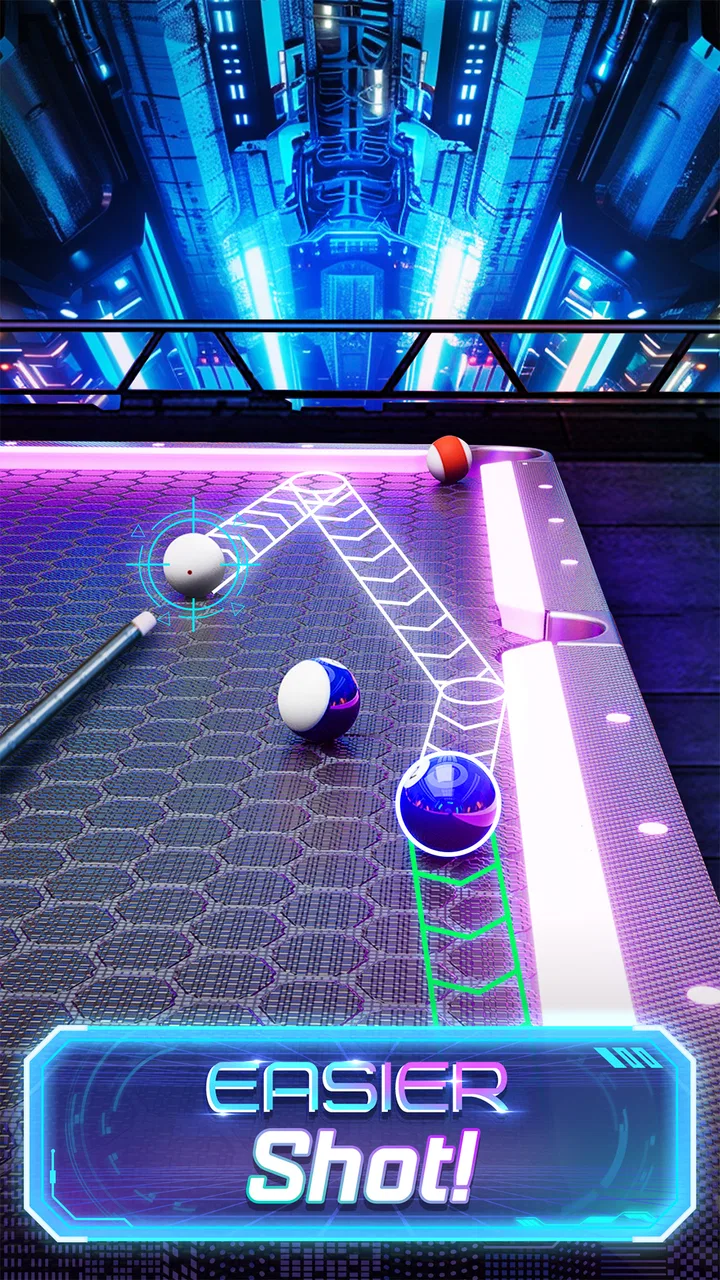
The controls are approachable enough for someone who has not played a mobile pool game recently. I could concentrate on lining up a shot and controlling its strength without first studying a long tutorial. That accessibility is one of the strongest reasons to recommend it to a friend who wants a sports game with a gentle learning curve.
At the same time, easy controls should not be confused with automatic success. Stronger shots can create unwanted movement, while a cautious shot may fail to reach the target or leave an opponent an open table. I learned to treat power as a positioning tool rather than merely a way to hit harder. On crowded tables, a modest shot often gave me more control over the next turn than an impressive-looking break.
A practical habit is to inspect the whole table before committing. I first look for a legal path, then consider where the cue ball is likely to stop, and only afterward decide whether the shot is worth the risk. This is especially helpful when a ball is close to a pocket but another target offers a much cleaner continuation. The game rewards that kind of restraint more than hurried tapping.
Another useful adjustment is to avoid treating every difficult shot as mandatory. If the angle looks poor, I would rather choose a defensive or setup-minded option when the situation allows it. That approach will not rescue every position, but it reduces the number of turns lost to ambitious attempts. Beginners may initially focus on sinking balls; after a few sessions, controlling the next position becomes the more valuable skill.
There is also a psychological difference between playing for a clean finish and playing merely to survive. Once I had only the eight ball left, I became more careful than before, sometimes to my detriment. The best response was to maintain the same process used earlier: check the angle, judge the required force, and avoid rushing because the end is close. That simple discipline made the final shot feel earned instead of lucky.
Why the free entry point works
The game is free to download, which makes trying it straightforward. Its age classification is Everyone, so it is positioned as a broadly accessible sports title rather than a game aimed at a mature audience. I would still advise parents to consider the presence of optional in-app purchases when deciding whether a child should play without supervision.
Those purchases range from $0.99 to $99.99 per item. That wide range is the main reason I would not describe the game as completely frictionless for every player. Someone who only wants occasional matches can simply treat the purchase layer as something to ignore, but players who become invested in progression should decide early whether they are willing to spend or prefer a strictly no-purchase approach.
My advice is to begin with a clear personal rule: play for a while without buying anything, then decide whether the free experience already gives enough value. This prevents the common mistake of spending just to remove a temporary obstacle or keep pace with a progression loop. The game is easiest to recommend when the player enjoys the matches themselves rather than viewing purchases as necessary for basic entertainment.
The broad adoption suggests that the format has found an audience. It has passed 10 million installs, carries an average rating of 4.4 from around 216 thousand ratings, and has about 28 thousand written reviews. I see those figures as evidence that the core idea connects with many mobile players, not as a guarantee that every person will enjoy the same pace or purchase structure.
Where the experience can become repetitive
The biggest weakness is repetition. Eight-ball is naturally replayable, but repeated matches can begin to feel similar when the player wants more variety than the central format provides. The worldwide-master framing adds context, yet it does not change the fundamental activity: aim, strike, clear the table, and attempt the final ball. For me, the game was strongest in short sessions and less convincing as an all-day pastime.
This limitation is not a problem for everyone. Pool fans often enjoy refining the same skill through repeated attempts, and the compact format makes that practice convenient. However, if you expect a sports title to offer several disciplines, extensive customization, or a large set of radically different challenges, you may prefer another option in the category. A broader billiards game would be a better fit for someone who wants to move between eight-ball, nine-ball, and other table formats.
The game can also punish impatience in a way that feels harsher than expected. One poor decision may give the opponent a clear route through the table, turning a comfortable position into a long recovery attempt. That is appropriate for competitive pool, but it can frustrate players who want a purely relaxing experience. I would not choose this as background entertainment while distracted, because successful play depends on paying attention to the table before each shot.
Another trade-off is the difference between accessibility and depth. The straightforward presentation helps new players start quickly, but experienced pool players may eventually want finer control and more demanding simulation. If your enjoyment comes from studying precise cue-ball behavior or reproducing real-world technique, a specialist simulator may offer more satisfaction. This game is better understood as an approachable mobile interpretation of pool than as a professional training tool.
Connection and session conditions can also influence whether a match feels convenient, particularly for anyone expecting a completely offline pastime. I would test the game in the places where I normally play it rather than assuming that every situation will be equally smooth. For a player who needs a dependable game on flights or in areas with unreliable service, a title designed explicitly around offline play may be the safer choice.
Small habits that make a noticeable difference
The first habit I recommend is planning the order of the balls. When several targets are available, I try to choose the one that leaves the cue ball near a useful line for the following shot. This is more important than selecting the easiest-looking ball. A slightly harder shot can be the better decision if it opens the table and avoids trapping the cue ball behind another target.
The second is to treat the break as a setup rather than a spectacle. A forceful opening can spread the balls, but it can also produce a difficult layout. I found it more useful to judge the break by what it creates afterward: open routes, manageable clusters, and a reasonable chance of continuing. The strongest-looking strike is not always the most practical one.
The third is to slow down near pockets and rails. Shots that appear simple can become awkward when the cue ball rebounds farther than expected or when the target is approached from a narrow angle. I prefer making a short pause before the final adjustment, particularly when a miss would leave the opponent a clear table. That pause costs almost no time and prevents many avoidable errors.
A fourth tip is to use early matches as observation sessions. Instead of focusing only on winning, I watch how much power produces different results and which layouts repeatedly cause trouble. This turns losses into useful information. It also helps separate a genuine control problem from a poor strategic choice, which makes improvement feel more concrete.
Finally, I would avoid judging the game after a single unlucky match. Pool has enough variance in table layouts and shot outcomes to make one session misleading. A better test is to play several short sessions on different days and ask whether the aiming process remains enjoyable. If the answer is yes, the game has a durable place in your rotation; if not, extra progression will probably not solve the underlying issue.
Who should install it, and who should look elsewhere
I recommend it to casual sports-game players who want a recognizable activity with immediate rules and room to improve. It is also a good match for people who enjoy replaying compact challenges instead of following a long story. Someone new to mobile pool can start without feeling overwhelmed, while a moderately experienced player can still find satisfaction in better positioning and safer shot selection.
It suits a player who likes a competitive edge but does not need a huge amount of content around it. The game can fill a short break, provide a simple routine after work, or offer a few focused matches before bed. Its free price makes experimentation easy, and the Everyone rating broadens its potential audience, although the optional purchase range deserves attention in family settings.
I would be more cautious about recommending it to serious billiards students, players seeking realistic practice, or anyone who dislikes repeated attempts at the same game type. I would also point genre enthusiasts toward a broader pool collection if they want multiple rule sets and more variation. In those cases, the focused eight-ball design is less a strength than a boundary.
Device compatibility is reasonably broad for an older Android handset, since the game requires Android 7.0 or later. The current release is version 2.69.0, so I would check that a device meets the operating-system requirement before planning to play on an older phone or tablet. That is a practical detail, especially for families sharing older devices or keeping a secondary phone for games.
My final take after weighing the trade-offs
Infinity 8 Ball™ Pool King succeeds because it understands the value of a clear, repeatable mobile match. I could open it, read the table, make a few decisions, and feel that a win came from better control rather than from navigating unnecessary complexity. Playorcas has created a sports game that is easy to approach while still giving careful players reasons to think ahead.
Its limits are just as clear. The focused eight-ball format may become repetitive, the purchase range means some players will want firm spending boundaries, and the experience does not replace a deeper billiards simulator. Those are not minor details, but they are manageable if expectations are realistic.
My recommendation is simple: try it if you want accessible eight-ball matches in short sessions, and skip it if you need broad sports variety or serious real-world training. For the right player, the combination of quick entry, familiar rules, and small strategic decisions makes it an enjoyable free addition to a mobile games library. I would keep it installed for occasional matches, not because it offers everything, but because it makes one thing—compact digital pool—pleasantly easy to return to.
FAQs for Infinity 8 Ball® Pool King
01What features does Infinity 8 Ball™ Pool King offer?
Infinity 8 Ball™ Pool King provides a realistic pool experience with stunning graphics and smooth gameplay. The app includes various game modes such as 8-ball, 9-ball, and snooker. It also offers online multiplayer capabilities, allowing you to compete with players worldwide. Additionally, there are tournaments, leaderboards, and customizable cues.
02Is Infinity 8 Ball™ Pool King free to play?
Yes, Infinity 8 Ball™ Pool King is free to download and play. However, the app offers in-app purchases for various items, such as premium cues and power-ups, which can enhance your gameplay experience. While these purchases can provide advantages, they are optional, and you can enjoy the game without spending money.
03What are the system requirements for Infinity 8 Ball™ Pool King?
Infinity 8 Ball™ Pool King is compatible with both Android and iOS devices. For Android users, the app requires Android version 5.0 or higher. iOS users will need iOS 10.0 or later. Ensure your device has enough storage space and a stable internet connection for the best gaming experience.
04How does the multiplayer mode work in Infinity 8 Ball™ Pool King?
In multiplayer mode, you can challenge friends or compete against random players globally. The game matches you with opponents based on your skill level, ensuring a fair and competitive experience. You can also join or create clubs, participate in tournaments, and climb the leaderboards to showcase your skills.
05Are there any tips for beginners playing Infinity 8 Ball™ Pool King?
For beginners, it's important to practice and familiarize yourself with the controls and physics. Start with single-player modes to build confidence before venturing into competitive play. Use the tutorial to understand game mechanics, and take advantage of practice modes to improve your aim and strategy.
Pros
- Highly realistic graphics enhance gameplay.
- Smooth controls for precise shots.
- Wide variety of cues and tables.
- Engaging multiplayer mode available.
- Regular updates with new features.
Cons
- In-app purchases can be pricey.
- Occasional connectivity issues.
- Limited offline play options.
- Ads can be intrusive at times.
- Requires significant storage space.

Infinity 8 Ball® Pool King
Gallery